Breaking up with Big Tech Part One
Jumping the Fence of the Walled Garden
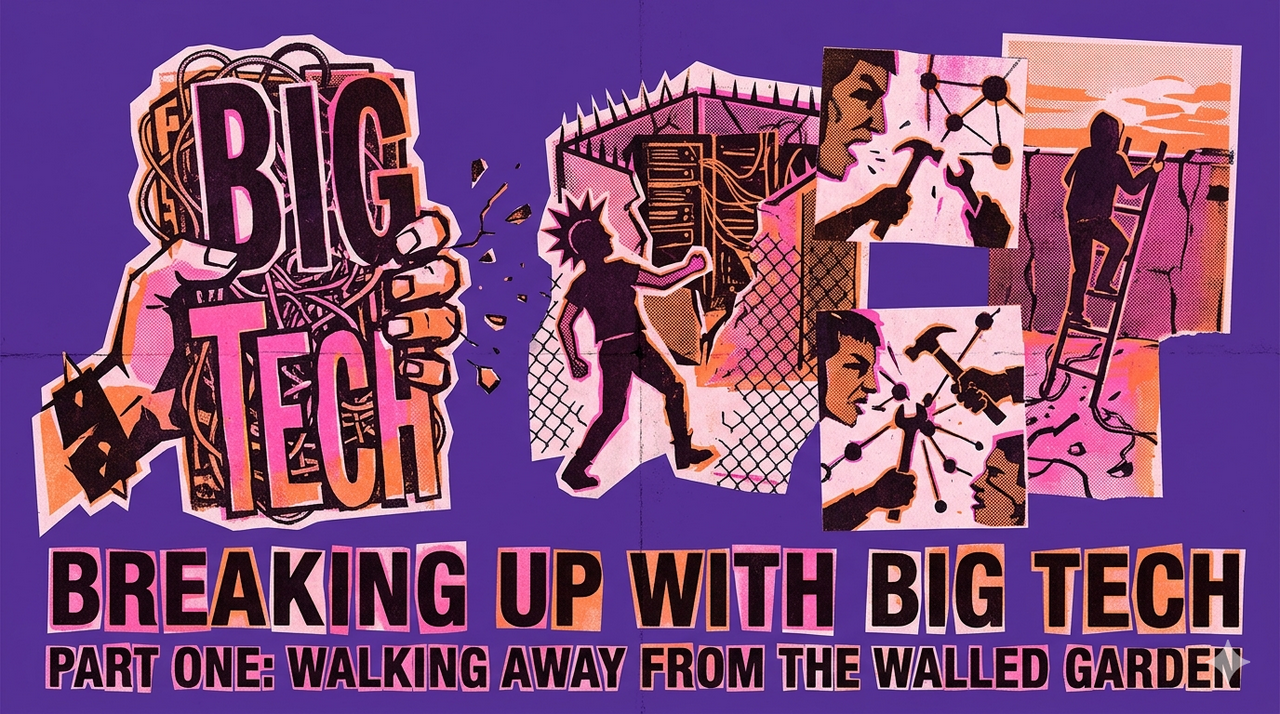
There's a version of freedom that looks a lot like a prison cell. The walls are clean. The lighting is warm. Everything has its place and works exactly as it should. Inside you're safe, protected, and sheltered from any outside threats. It's so comfortable, you didn't notice the door lock behind you while you were admiring the edgy yet industrial finish on your new laptop.
That's Apple's walled garden.
The “garden” metaphor is amazing marketing on Apple's part — gardens are cultivated, beautiful, safe. You're not trapped; you're tended to. But spend enough time inside and the metaphor starts to crack. Try to leave and you'll find your photos are in a proprietary format (HEIC format anyone?), your messages won't port cleanly (iMessage plays nice with no one), your music library is leased not owned, and every subscription you added for convenience has quietly become load-bearing infrastructure in your daily life. The garden was never really yours. You weren't invited to enjoy the luscious greenery or experience the calm of walking through a beautiful botanical garden barefoot. No, my friend, you are a crop.
Apple has spent decades building the most elegant extraction machine in consumer technology. Not through surveillance dashboards or creepy ad targeting — that's Google's aesthetic. Apple's method is subtler: make the cage beautiful, make the lock feel like a feature, and charge a premium for the privilege of staying in. While everyone was watching Google and Meta, Apple quietly pockets $18 billion a year from Google to remain the default search engine on every iPhone — meaning every Apple device is, functionally, a Google search terminal with better margins and a cleaner logo.
I spent years rationalizing how staying in the walled garden was the best choice for my wallet, my data, and my family's digital safety. But the rationalizations were just the cage talking. You're not a customer in this ecosystem. You're inventory.
So I decided to leave.
The Enshittification of Cool
In 2022, writer and activist Cory Doctorow coined a term that instantly explained something millions of people had felt but couldn't name: enshittification. The enshittification process looks like this — a platform first makes itself useful to attract users, then it leverages those users to attract business customers, then it squeezes both to extract maximum value for shareholders. You've watched it happen to Facebook, Amazon, Uber, and Google in real time. The feeds got worse. Prices went up while quality went down. The search results filled with ads. The recommendations became indistinguishable from paid placements. Features that were once part of the service were turned off and paywalled as an 'upgrade.'
But Apple? Apple gets a pass. Apple is supposed to be different.
The problem is, it isn't.
Apple's enshittification just wears better clothes. The process is the same, the aesthetic is different. Where Google's extraction is loud and obvious — your Gmail is read, your searches are profiled, your location is sold — Apple's is architectural. The extraction isn't in what they read. It's in what they've built around you.
Consider the trajectory. In the early 2000s Apple genuinely was the scrappy alternative. The “Think Different” campaigns weren't just marketing, they reflected a real product philosophy — elegant hardware, open file formats, interoperability. iTunes could sync with non-Apple devices. The ecosystem was porous by design. Apple needed users and users needed Apple.
Then came the iPhone, and the calculus changed permanently.
With a captive mobile platform came the App Store — a 30% tax on every digital transaction run through it, enforced by the only company with the keys to the store. Then came iCloud, which made your data convenient to access and inconvenient to move. Then came Apple One, a bundle so frictionless it practically subscribes itself, tying music, storage, news, fitness, and television into a single monthly charge that feels reasonable right up until you try to cancel any piece of it and realize how much of your digital life has been quietly load-bearing on Apple's infrastructure.
And then there's the Google deal.
Every year Apple accepts somewhere between $18 to $20 billion from Google to remain the default search engine across all Apple devices. Cory Doctorow explains;
“Apple's single largest source of revenue is a check for more than $20 billion that Google writes it every year to buy the default search box in Safari and on the iPhone. That $20+ billion check is also Google's single largest expenditure.” (Enshittification: Why Everything Suddenly Got Worse and What to Do About it, p. 81)
That's not a partnership. That's Apple selling its users' attention and search behavior to the largest surveillance capitalist on the planet — and pocketing the check while marketing itself as the privacy-first alternative. Apple's App Tracking Transparency framework, which made headlines for cracking down on Meta's ad targeting, didn't eliminate surveillance capitalism from the iPhone. It consolidated it. Third-party trackers got squeezed while Apple's own ad business quietly grew.
This is the genius and the con of Apple's brand. The cage is presented as protection. The lock is marketed as privacy. And the premium you pay for the hardware is framed as a values statement — I care enough about my data to pay more — when the reality is: I paid Apple more to make me feel better while they extracted from me more elegantly.
Doctorow's enshittification framework names what's happening, but Apple adds a layer that makes it particularly insidious: the process is slow, tasteful, and wrapped in the language of user empowerment. You don't notice the squeeze because the squeeze comes with a premium price tag, liquid glass, and 'cult of mac' aura.
Pulling Out the Hook: How I Escaped Apple One
Before we get practical, we need to name the mechanism that makes leaving any Big Tech ecosystem feel impossible: switching costs. Again, Cory Doctorow explains;
“Switching costs are everything you have to give up when you switch from one product or service to another.” (Enshittification: Why Everything Suddenly Got Worse and What to Do About it, p.13)
Tech companies know switching costs are a pain in the ass, that's how they've designed it to work. It's not a bug, it's the business model. Apple didn't design HEIC photo formats, iMessage lock-in, and iCloud's proprietary sync because they were the best technical solutions. They designed them because every hour you spend dreading the migration is another month of subscription revenue. Big Tech doesn't need to build a better product forever — they just need leaving to feel harder than staying. Once you name switching costs for what they are — a retention strategy dressed up as an ecosystem — the intimidation starts to dissolve. Yes, there's work involved in leaving. But it's a finite amount of work that purchases an indefinite amount of freedom. Here's how I did it.
iCloud → MEGA
iCloud is the connective tissue of the Apple ecosystem — it's in your photos, your documents, your device backups, your passwords. Apple knows this, which is why 5GB of free storage is a cruel joke designed to funnel you into a paid plan as fast as possible. The switching cost here is psychological more than technical: your stuff feels safe in iCloud because Apple has spent billions making sure it feels that way.
MEGA offers 20GB of free encrypted cloud storage with end-to-end encryption baked in by default — not as a premium feature, not as a marketing claim, but as the architectural foundation of how the service works. Your files are encrypted before they leave your device, meaning MEGA can't read them even if they wanted to. For documents, backups, and general file storage, it does everything iCloud does without the Apple tax or the surveillance architecture underneath.
Cost: Free
Apple Photos → Ente
Photos are the highest-stakes switching cost in the Apple ecosystem. Years of memories, locked in HEIC format, organized in Apple's proprietary library structure. The thought of migrating them feels like moving a house one brick at a time. But Ente makes the process manageable — and the peace of mind on the other side is worth every minute of it.
Ente is open-source, end-to-end encrypted, and built specifically to be the privacy-respecting alternative to iCloud Photos and Google Photos. There are no algorithms scanning your family photos to serve you better ads. There's no facial recognition data being harvested. Your photos are yours — fully, actually, not just in the terms of service fine print.
Cost: $119.88/year (1TB family plan)
Apple Music → Tidal + Physical Media
Apple Music is a masterclass in the leased life. You pay monthly for access to music you don't own, on a platform you don't control, through an app Apple can revoke access to at any time. The moment you stop paying, the library goes dark. That's not a music collection. That's a rental agreement dressed up as a lifestyle.
We switched to Tidal for our streaming needs — lossless audio quality, a better royalty model for artists, and no Apple infrastructure required. But streaming alone still felt like renting, so we've also started doing something that felt almost countercultural at first: buying physical media.
At least once a month my family jumps in our SUV and makes an adventure out of looking for vinyl records, CDs, and Blu-rays of our favorite bands and movies. We also take our time to peruse, compare prices, and find the best deals before making a purchase. When you own a record, no corporation can revoke your license to it. No subscription lapses. No platform shutdowns.
The music is yours in the most literal sense — it exists as a physical object in your home that will outlast any streaming service's terms of service. In a culture that has normalized renting everything from movies to music to software, choosing to own the art you love is a quiet but meaningful act of resistance.
Tidal cost: $16.99/month
Apple Notes → Craft
Apple Notes is the stickiest switching cost most people don't see coming. Notes accumulates years of thinking — meeting notes, journal entries, half-finished ideas, grocery lists that somehow became important. It's invisible infrastructure. And because it syncs so seamlessly across Apple devices, you never feel the lock-in until you try to leave.
Craft is a genuinely excellent notes and document app that puts Apple Notes to shame on nearly every dimension that matters. It's fast, beautifully designed, works offline by default, and doesn't treat your notes as data to be mined. The family plan means everyone in the house gets access, and the export options are robust enough that your notes will never be held hostage to Craft's continued existence either.
Cost: $108/year (family plan)
Apple Mail → HEY
Email is perhaps the most loaded switching cost in the entire digital ecosystem — not because the migration is technically hard, but because your email address is your digital identity. It's on your business cards, your accounts, your decade-old forum registrations. Changing it feels like changing your name. (I should know — I've changed mine more than once)
HEY reframes what email can be. Built by 37Signals, it has no ad model, no data harvesting, and no interest in monetizing your inbox. The screening features alone — where you approve who gets to email you in the first place — make it feel like a fundamentally different relationship with a medium that has spent twenty years becoming unusable. The cost is real, but so is the relief.
Cost: $179/year
Apple News → MeansTV
Apple News is the most ideologically compromised service in the Apple One bundle — a corporate-curated feed of corporate-owned media, optimized for engagement and ad revenue, dressed up as staying informed. It is surveillance capitalism's delivery mechanism for the news.
MeansTV is its structural opposite. Worker-owned, cooperatively run, and explicitly anti-capitalist in its editorial mission. For $10 a month you get access to independent documentaries, news, and original programming made by people who aren't beholden to shareholders or ad buyers. It won't replace every media habit, but as a deliberate alternative to algorithmically curated corporate news, it's exactly what it claims to be.
Cost: $10/month
The Real Cost Comparison
When I added it up, the switch wasn't the financial sacrifice I'd been telling myself it would be. Apple One's Premier plan runs $37.95/month — $455.40 per year — for a bundle of services engineered to deepen your dependency on a single corporate ecosystem.
My current stack runs roughly $65/month when averaged across annual plans. The difference is real but not budget breaking for my family. What isn't modest is the difference in what that money funds, who controls my data, and how much friction now stands between me and leaving any single service if it stops serving my values.
You're not saving money by staying in the walled garden. You're paying a premium for the privilege of being harder to move.
Your Money is Your Power
Here's something the financial services industry accidentally got right: every dollar you spend is a vote for the kind of world you want to live in. They meant it as an argument for ethical investing. I mean it as something sharper. It's the power every individual has to stand up to tech oligarchs and say, “I'm tired of this exploitative bullshit.”
When you pay Apple, Google, Meta, Amazon, or Microsoft every month, you are actively funding the infrastructure of techno-feudalism. You are bankrolling the lobbying that fights right-to-repair legislation. You are subsidizing the App Store taxes that strangle independent developers. You are paying for the surveillance architecture that profiles your children. You are financing the concentration of wealth and power into five companies that have more economic influence than most nation-states outside of China and the US. Every subscription renewal is a quarterly earnings beat for a company that has explicitly decided your dependency is more valuable than your freedom.
This isn't an accident. It's the model.
Cory Doctorow calls it techno-feudalism — a system where the platforms own the land, set the rules, collect the rent, and evict you if you cause trouble. You don't own your digital life. You lease it, on terms you didn't negotiate, from landlords who can change the lease whenever they feel like it. In the digital enshittification world we are all techno-sharecroppers. It's how the system was designed. And the system runs on your money.
The greatest asset any individual holds in a capitalist society isn't their labor, their credit score, or their network. It's their capital — however modest — and the daily decisions about where it flows. Choosing not to give your money to the five companies most aggressively extracting value from your life is not a consumer preference. It's a revolutionary act. It's a refusal. It's a small, daily declaration that the exploitation, enshittification, and techno-feudalism are not okay! It's a middle finger letting the oligarchy know you will not fund them quietly while telling yourself you have no choice.
You have a choice. It comes with switching costs, some monetary, some Saturday afternoons migrating data, and some adjustment to new tools. But it is finite work that purchases indefinite freedom.
In the 2014 film World War Z, Brad Pitt's character watches a family freeze in their apartment, surrounded on all sides by zombies, paralyzed by the scale of what they're facing. He turns to them and says simply: “Movimiento es vida.” Movement is life.
In a zombie apocalypse, or any apocalypse for that matter, comfort is a death sentence. Those who stay put, waiting for someone else to fix it, don't make it. Those who move — even imperfectly, even scared, even without a complete plan — do.
We are in a digital zombie apocalypse. Just look at Elon Musk's acquisition of Twitter, now 'X.' Twitter is now a an endless stream of lies, supported by a neo-Nazi empathizer who has given that movement a global voice via the platform. Again Doctorow shares;
“Twitter is a cautionary tale. It tells us that the “market forces” that we'd expect to kill off services that turn into piles of shit have been neutralized. We are living in an age of zombie platforms: platforms that shamble on long after they should have been double-tapped and stuffed in a shallow grave.” (Enshittification: Why Everything Suddenly Got Worse and What to Do About it, p.51-52)
We are in a moment where the platforms that mediate nearly every dimension of our lives are accelerating their extraction, tightening their grip, and betting that the switching costs will keep us frozen. The Big Five are counting on your inertia. They have engineered your dependency and they are waiting for you to decide that leaving is too hard.
It isn't.
Move.
In Part Two of Breaking Up with Big Tech, I'll walk through how I broke away from big social media and the surveillance capitalism economy — and what I replaced it with.
Hey Rebel is supported by mutual aid sustainers, not paywalls. If you have the means and want to keep this work accessible for everyone, consider contributing on Ko-fi. Solidarity means no one gets left behind.